
Article
Visitor Management Software for Offices: A Buyer's Guide
Visitor management software for offices swaps paper logbooks for iPad kiosks that print badges, capture NDAs, and alert hosts when a guest arrives.
By InstaCheckin Team Updated June 29, 2026
Five offices, five front desks, five paper logbooks — and no single place to answer “who was in the Denver building last Tuesday?” That’s the wall most growing companies hit. A clipboard scales fine for one lobby and falls apart the moment you’re running more than one.
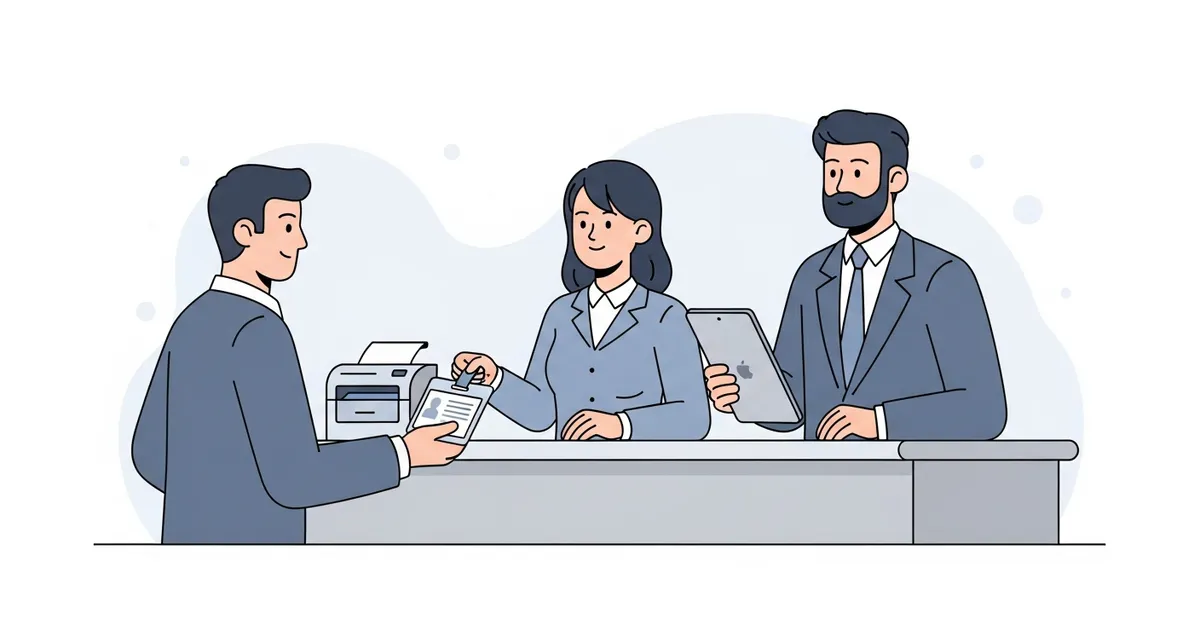
Visitor management software for offices replaces those scattered logbooks with one iPad kiosk per desk and one cloud log behind all of them. A visitor signs in on the iPad, a badge prints, the host gets an email and a text — and every visit, at every site, lands in the same searchable record. This guide covers what the software does, how it behaves once you’ve got more than one office, and how to tell a tool that actually scales from one that only demos well.
For the feature-by-feature product picture on a single site, the office visitor management system buyer’s overview goes deeper on each capability.
What Visitor Management Software for Offices Does
Strip the marketing and the job is narrow. From the moment a visitor reaches the desk, an office sign-in system does four things:
- Logs the visit — name, company, who they’re here to see, arrival time, and an optional photo.
- Collects a signature — an NDA, a safety waiver, or an export-control notice, signed on the touchscreen and filed with the visit record.
- Notifies the host — email and SMS the second sign-in finishes, with the visitor’s name and photo attached.
- Prints a badge — name, photo, host, and date, sent to a connected Brother QL label printer before the guest walks off.
Every visit then drops into a cloud log you can filter by date, host, or name and export to CSV or PDF. That’s the whole loop. If you’re still mapping the category itself, what a visitor management system is explains where it sits between a clipboard and full physical security.
Running It Across More Than One Office
Here’s where the plural in “offices” earns its keep. One lobby barely needs software. Several lobbies need it badly, because the headaches compound: five logbooks, five retention habits, and five receptionists each improvising their own version of “did you sign in?”
Software billed per location keeps the math honest. Each desk runs its own iPad — InstaCheckin supports up to five kiosks per location — and you pay by building, not by headcount. Add an office, add a kiosk. You’re not re-buying the platform. Hosts and kiosks scope per site while every visit rolls up into one central log, so a question like “who visited the Austin office on the 14th?” becomes a filter instead of a phone tree.
That central record is also what makes visitor pre-registration worth switching on everywhere: a host in one office can register a guest arriving at another, and the kiosk there already knows them. The hardware is short and identical at every desk — one iPad, a stand, and a Brother QL badge printer if you print badges — so your fifth rollout looks exactly like your first.
Where the Receptionist’s Time Goes
Under the paper system, every walk-in costs the receptionist the same three steps: notice the guest, work out who they’re here for, then call or walk over to fetch that person. Multiply by every visitor, across every site, every day.
A sign-in kiosk deletes the third step. When check-in finishes, the host gets an email and a text with the visitor’s name and photo — no relay needed. That matters most when the desk is also the switchboard, because a receptionist can’t greet a walk-in and answer a ringing line in the same second, and the visitor is the one who ends up waiting. Some offices pair the kiosk with an AI receptionist for overflow and after-hours calls so the phones keep moving while the iPad handles the lobby. Either way the idea is the same — take the repeatable work off the person and let them handle the exceptions. That’s the core of front-desk automation, and it’s where the payoff compounds once you’re running several buildings.
The Privacy Leak a Paper Logbook Can’t Fix
A clipboard quietly does something no office actually wants: it shows your last visitor’s name, company, and phone number to your next one. Everyone who signs reads the entries above theirs.
That’s a real concern for any office handling personal data under the GDPR’s data minimisation principle in Article 5, or for California businesses under the California Attorney General’s overview of the CCPA. A digital sign-in closes the leak by design — each visit goes straight to a secured admin portal, visible only to authorized staff, and you can set retention windows so old records are purged automatically. This describes a common privacy risk, not legal advice. GDPR and CCPA obligations depend on your specific data-processing context; consult counsel before relying on this for compliance decisions.
NDAs get the same treatment. The document is shown on-screen, signed with a fingertip, and the signed copy is archived with that visit — name, date, and time bound together, no screenshots required. Electronic-record and e-signature enforceability varies by jurisdiction; this describes a product feature, not legal advice.
Staffed Desk or Empty Lobby — Both Work
Most office visitor software is built to run unattended. The visitor uses the kiosk directly, the host is notified automatically, and nobody has to stand at the desk. That suits a busy reception and an after-hours lobby equally.
The detail that trips people up is how locked-down the iPad needs to be. For a staffed desk, Apple’s built-in Guided Access feature, documented in Apple Support, pins the iPad to the sign-in app in about a minute. It’s free, and it’s enough for most offices. For an unstaffed lobby you want the app to relaunch by itself after a reboot, which Guided Access won’t do — that’s the case for MDM-managed Single App Mode. The full iPad kiosk mode guide lays out both methods with honest tradeoffs on what each one survives, which matters more once you’re locking down a fleet across sites.
FAQ
What does visitor management software for offices do?
It runs on a front-desk iPad and handles four jobs the paper book can’t: it logs the visit, collects an NDA or waiver signature, prints a badge, and notifies the host by email and SMS the second sign-in finishes. Every visit lands in a searchable cloud log you can filter and export later, instead of a spiral notebook on the counter.
Can one account cover multiple office locations?
Yes. The software is billed per location, so each desk runs its own iPad while every visit rolls up into one central log. Hosts and kiosks scope per site, which means answering “who was in the Austin office on the 14th?” is a filter, not a round of phone calls to five receptionists.
Does an office need a receptionist for the kiosk to work?
No. A self-service kiosk runs unattended — the visitor signs in, the badge prints, and the host is notified automatically. For an unstaffed lobby, lock the iPad to the sign-in app with Single App Mode so it relaunches on its own after a reboot. The pricing page has current per-location rates if you’re budgeting a multi-site rollout.
How is digital sign-in more private than a paper logbook?
A paper book shows every previous visitor’s name, company, and phone number to the next person who picks up the pen. Digital records go straight to a secured admin portal visible only to authorized staff, and you can set retention windows so older entries are purged on a schedule you choose.
Put One iPad on the Front Desk
The lowest-risk way to judge visitor management software for offices is to run it on one desk for a week before you think about the other four. Send real visitors through it, and watch whether the host notifications and the printed badge change the lobby enough to roll it out further. You’ll know fast.
For the full product picture, see the office visitor management system page. Start a free trial and have your first kiosk taking visitors before the end of the week — then clone the setup to the next office when you’re ready.
Frequently asked questions
What does visitor management software for offices do?
Can one account cover multiple office locations?
Does an office need a receptionist for the kiosk to work?
How is digital sign-in more private than a paper logbook?
Related reading
Front Desk Automation: 5 Tools to Cut Manual Reception Work
Five front desk automation tools for office managers: digital visitor sign-in, AI call handling, online booking, badge printing, and pre-registration.
Office Visitor Management System: A Buyer's Overview
An office visitor management system replaces paper logbooks with a digital kiosk that notifies hosts, prints badges, and keeps visitor records searchable.
Visitor Management System for Office: A Practical Guide
How a visitor management system for office front desks replaces the paper logbook with an iPad kiosk that prints badges, captures NDAs, and notifies hosts.