
Article
Front Desk Visitor Management: A Guide for Offices
How front desk visitor management replaces the paper sign-in book with an iPad kiosk that prints badges, captures NDAs, and notifies hosts the moment a guest arrives.
By InstaCheckin Team Updated June 19, 2026
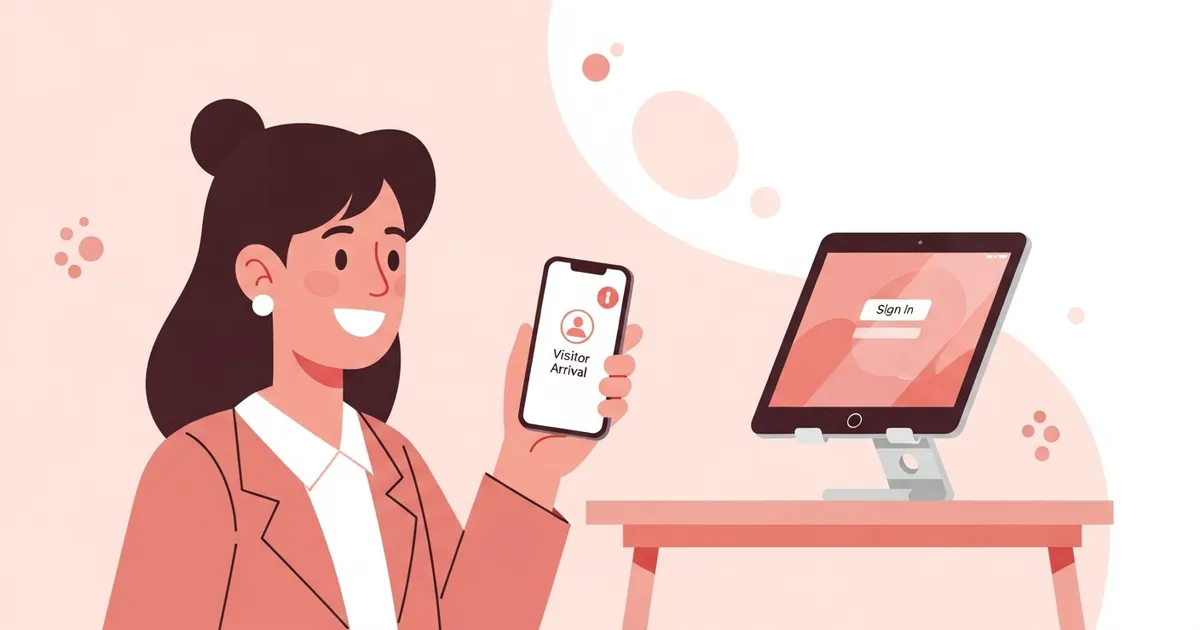
A guest arrives at 9:02 for a 9:00 meeting. The receptionist is on a call. The paper sign-in book sits open on the counter with the last six visitors’ names and phone numbers in plain view. The guest waits. Upstairs, the host has no idea anyone has shown up.
Front desk visitor management is the set of steps that turns that scene into a non-event. The visitor signs in on an iPad, a badge prints, and the host gets pinged automatically — no one at the desk has to make a call or walk over. This guide covers what the system does, when the paper book becomes a liability, and how to roll it out without overbuying.
If you want the longer feature-by-feature breakdown, the office visitor management system buyer’s overview goes deeper on each capability.
What Front Desk Visitor Management Actually Does
Strip away the marketing and the job is small and specific. The moment a visitor walks up to the desk, an office sign-in system handles four things:
- Captures the visit — name, company, reason for visiting, arrival time, and an optional photo.
- Collects consent — an NDA, a safety waiver, or an export-control notice, signed on the touchscreen and stored with the visit record.
- Notifies the host — an email and SMS the instant check-in completes, with the visitor’s name and photo attached.
- Prints a badge — name, photo, host, and date, printed to a connected Brother QL label printer before the visitor steps away.
The visit then lands in a searchable cloud log you can filter by date, host, or name and export to CSV or PDF. That’s the whole loop. If you’re still mapping the category itself, what a visitor management system is explains where it sits between a clipboard and full physical security.
When the Paper Logbook Becomes a Liability
A clipboard is fine for an office with three visitors a month. The failure modes show up as volume climbs, and they’re predictable.
The first is privacy. Anyone signing the paper book reads the entries above theirs — a real concern for any office handling personal data under the GDPR’s data minimisation principle in Article 5, or for California businesses under the California Attorney General’s overview of the CCPA. This describes a common privacy risk, not legal advice. GDPR and CCPA obligations depend on your specific data-processing context; consult counsel before relying on this for compliance decisions.
The second is the dead-air gap between arrival and greeting. Someone has to notice the guest, then track down the host. When reception is also fielding the phones, that gap stretches — which is why some offices pair the kiosk with an AI receptionist for overflow and after-hours calls so the front desk isn’t choosing between the walk-in and the ringing line.
The third is retrieval. When counsel or an auditor asks for a timestamped record of who was in the building on a given afternoon, “we have a clipboard somewhere” isn’t an answer. None of these is fatal alone. Together they’re why most offices that switch to a digital sign-in don’t go back.
The Hardware: One iPad, One Stand, One Printer
The hardware list is short. One iPad per check-in point, a counter or floor stand, and a Brother QL badge printer if you want printed badges. InstaCheckin supports up to five kiosks per location, so a single front desk needs exactly one iPad — you don’t pay for capacity you won’t use.
The decision that trips people up isn’t the printer. It’s how locked-down the iPad needs to be. For a staffed desk, Apple’s built-in Guided Access feature, documented in Apple Support, pins the iPad to the sign-in app in about a minute. It’s free, and it’s enough for most offices.
For an unstaffed lobby, you want the app to relaunch on its own after a reboot, which Guided Access won’t do. That’s the case for iPad Single App Mode, which survives restarts and is the right call for a self-service kiosk no one is watching.
Rolling It Out Across One Desk or Ten
A single office is a same-day job. Install the iPad app, sign in to the admin portal, import your host directory, pair the printer, and you’re taking visitors. The longer pole is deciding which NDA or waiver each visitor type signs, and whether to switch on visitor pre-registration so expected guests skip data entry at the desk.
Multi-location is mostly coordination, not engineering. Each site runs its own kiosks, hosts are scoped per location, and the central log rolls everything up for reporting. Pricing is billed per location, so cost scales with your footprint rather than your headcount — the current tiers are on the pricing page.
This is where front-desk automation pays off most. The per-visitor manual work that’s tolerable at one desk becomes a real tax across ten. Removing the receptionist’s notify-the-host step at every site is the win that compounds.
FAQ
Is front desk visitor management overkill for a 20-person office?
Probably not, if you get even a handful of visitors a week. The hardware is an iPad and a label printer, and the payoff shows up in soft places: no reception phone-tag, a faster lobby, and searchable NDAs and photos when someone needs them later.
Does the kiosk work without internet?
The iPad needs a connection to send host notifications and sync the visit to the cloud log in real time. Most offices already have reliable Wi-Fi at the front desk. If your lobby signal is weak, hard-wiring the network or adding an access point near reception solves it before launch.
Can I require an NDA only for certain visitors?
Yes. Documents route by visitor type, so contractors can sign a safety waiver while interview candidates sign an NDA and delivery drivers sign nothing. Each signed document is archived with that visit’s record. Electronic-record and e-signature enforceability varies by jurisdiction; this describes a product feature, not legal advice.
What happens to the visitor data we collect?
Every visit is stored in a secured cloud log with timestamps and any captured photo, visible only to authorized staff in the admin portal. You can filter and export records for reporting and set retention windows so older entries are removed on a schedule you choose.
Put One iPad on the Front Desk
The lowest-risk way to evaluate front desk visitor management is to put one iPad on one desk and run real visitors through it for a week. You’ll know fast whether the host notifications and the printed badge change the lobby enough to justify rolling it out further.
Start a free trial and set up your first kiosk in under an hour — no receptionist required to keep it running.
Frequently asked questions
What is front desk visitor management?
Do I need a receptionist for front desk visitor management?
How is a digital front desk more private than a sign-in book?
How long does front desk visitor management take to set up?
Can visitors check in before they arrive?
Related reading
Front Desk Automation: 5 Tools to Cut Manual Reception Work
Five front desk automation tools for office managers: digital visitor sign-in, AI call handling, online booking, badge printing, and pre-registration.
Office Visitor Management System: A Buyer's Overview
An office visitor management system replaces paper logbooks with a digital kiosk that notifies hosts, prints badges, and keeps visitor records searchable.
Visitor Management System for Office: A Practical Guide
How a visitor management system for office front desks replaces the paper logbook with an iPad kiosk that prints badges, captures NDAs, and notifies hosts.